FOR IMMEDIATE RELEASE
31 August 2026
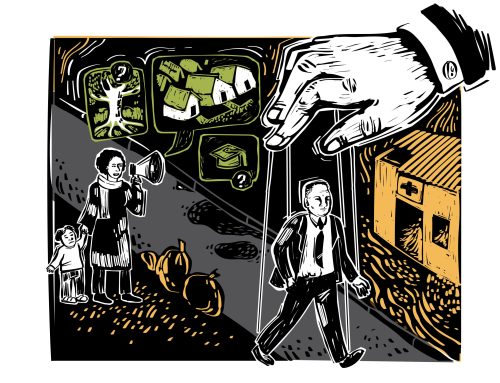
We know who donated. But do we know who is behind the money?
My Vote Counts calls for stronger political funding disclosure as R116.8 million is declared in a single quarter
My Vote Counts (MVC) welcomes the publication by the Electoral Commission of South Africa (IEC) of the latest political party funding disclosures.
The disclosures provide an important window into who is financing South Africa’s political parties ahead of the 2026 Local Government Elections. But they also expose a deeper problem: transparency is only meaningful if voters can actually understand who is behind the money.
In the first quarter of the 2026/27 financial year, four political parties declared a combined R116.8 million in donations. The Democratic Alliance (DA) accounted for approximately R104 million – nearly 89% of the total. By comparison, approximately R175 million was declared in private political donations across the entire 2025/26 financial year. These figures make it increasingly important to look beyond simply who donated and ask what these donations tell us about political influence.
When one donor becomes two companies
The latest disclosures raise questions about corporate influence and the limits of the current donation framework. The DA declared R30 million from Fynbos Ekwiteit (Pty) Ltd and R25 million from Fynbos Kapitaal (Pty) Ltd, two entities connected to Capitec founder Michiel le Roux. Together, the entities contributed R55 million to the party in a single quarter. These donations may comply with the current legal framework because they were made by separate legal entities.
But their combined value raises an important question: does our political funding framework adequately account for connected entities and common beneficial ownership when assessing the concentration of political influence?
We are not suggesting that these donations are unlawful. Our concern is that voters should not have to conduct their own investigation to establish whether apparently separate donors are connected, who ultimately controls them, and what interests may lie behind significant political contributions. This is not a new concern for MVC. Our ongoing litigation challenging the constitutionality of the Political Funding Act seeks, among other things, to regulate and limit cumulative donations made by related donors. The latest disclosures underscore the importance of this challenge.
“Mr M” is not enough
The problem is not limited to corporate donors. Individual donors also appear in IEC disclosures with incomplete names or initials – for example, “Mr M Moshal” or “Mr D Barnes”. Where a donor has a public profile, it may be possible to identify them through additional research. Where they do not, identification can be practically impossible.
That should not be the standard. Voters should not have to search the internet, cross-reference records or submit PAIA applications simply to establish who has donated significant sums to a political party. The information necessary to identify donors should be part of the disclosure itself.
We recognise the need to balance transparency with privacy and data protection. But PAIA should not compensate for inadequate political funding disclosure in the first place.
Are parties complying?
The ANC’s continued non-compliance with the Political Funding Act is concerning and appears to be part of a recurring pattern. It is particularly disappointing that the country’s largest political party continues to fall short of obligations under legislation designed to strengthen transparency and accountability in political funding.
Political parties cannot demand the public’s trust while failing to meet the transparency obligations that come with participating in our democracy. The IEC must ensure that the rules apply equally to all parties, regardless of their size or political standing.
And what about the Multi-Party Democracy Fund?
The disclosures also raise questions about South Africa’s alternative model for political funding. The Political Funding Act established the Multi-Party Democracy Fund (MPDF) to allow private donors to support represented political parties without directing their money to a particular party. Yet donors continue to favour direct contributions to individual parties.
That matters because where money goes can say something about what donors want from their political giving. Direct political donations can create relationships of access and influence with particular parties, while contributing through the MPDF supports the broader multi-party democratic system. If donors are serious about strengthening South Africa’s democracy, they should consider whether their money is better used to support democracy as a whole, rather than securing influence with individual political parties.
The public has a right to follow the money
Political funding transparency must evolve beyond simply publishing lists of donors. Knowing the name of a legal entity is not necessarily the same as knowing who is behind a donation. Knowing that “Mr M” donated millions is not the same as making that donor meaningfully identifiable.
Voters have a right to understand the sources of political influence shaping their democracy. We therefore intend to:
- engage the IEC on improving the accessibility and identifiability of donor information;
- examine the relationship between political funding, beneficial ownership and access to information;
- monitor patterns of donations through connected entities; and
- monitor compliance by political parties and donors.
As the 4 November local government elections approach, political funding will only become more significant.
The question is not simply “Who donated?”
It is: Who is behind the money, what interests do they represent, and what does their money mean for our democracy?
We’ll keep following the money – and we invite South Africans to follow it with us. Our Whose Vote Counts tool has been updated with the latest disclosures to help you do just that.
ENDS
For more information or media enquiries, contact:
Noxolo Mfocwa (Advocacy Lead, My Vote Counts)
Email: communications@myvotecounts.org.za
Calls & WhatsApp: +27762723782